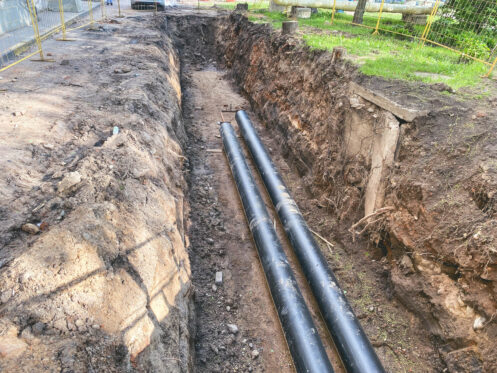
All the drains in your Frederick, MD home converge onto a single sewer line. This line travels underground from your property to the municipal sewer main. It carts all of your waste and wastewater away and plays an important role in maintaining the health and habitability of the entire building. Buried and largely out of sight and out of mind, this important plumbing component is all too easy to overlook.
To help you spot developing issues before they spiral out of control, the following are six of the most common sewer line problems.
1. Sewer Line Encroachment
Trees prevent soil erosion by holding dirt firmly in place with strong and fast-growing roots. They also provide shade and boost property values and aesthetics. Many popular trees even bear fruit. Unfortunately, despite these benefits and more, your trees have the potential to wreak havoc on your plumbing system.
Tree roots thrive with access to the moisture and nutrient-dense waste that sewer lines contain. If your sewer line has tiny cracks or other openings that are leaching moisture and nutrients into nearby soils, your trees’ roots will grow toward them. Even minor points of ingress can help tree roots gain purchase. Once they do, they’ll gradually expand and widen openings. Their continued growth will block the interior of your sewer line.
This is also the case with many underground weeds. While fast-growing tree roots and weeds might permit some liquid effluence and solid waste to get by, they can eventually cause dangerous whole-house backups. During a whole-house backup, all the waste that has recently exited your home will come rushing back into your drains and connected plumbing appliances. This waste is rife with biological and chemical contaminants that could cause serious illness.
During the early stages of a sewer line encroachment, you might hear bubbling or gurgling sounds coming from your drains or toilets, even when no one is actively using your plumbing system. These noises mean that trapped water is finally clearing an in-pipe obstruction. Other noticeable signs of tree root encroachment and an impending whole-house backup include:
- Pervasive sewer gas odors
- Sudden increases in greenery near sewer line
- Multiple blocked or slow-moving drains
- Recurring drain clogs
You can limit the risk of sewer line encroachment by regularly weeding your yard and practicing good general landscape management. You should also follow the tree planting guidelines issued by the City of Frederick for protecting underground utilities. It’s also important to note that even tree stumps can have growing roots that threaten sewer lines.
2. Cracked Sewer Lines
At one time, most sewer pipes were made from terracotta or baked clay. Even when fully intact, these pipes were prime targets for encroachment. Their more permeable materials made it easy for tree roots and underground weeds to create their own points of ingress.
Now, many new homes have PVC or ABS plastic sewer pipes. When these pipes are encroached upon, expansion caused by growing roots can create large and fast-spreading cracks in their walls. Although significantly more root-resistant than terracotta, they’re also more likely to sustain severe structural damage as the result of encroachment.
Encroachment isn’t the only cause of cracked sewer lines. Sewer lines can crack as the result of shifting soils, external pressure caused by heavy items, and general age-related wear. Unfortunately, irrespective of their materials, all sewer lines can eventually crack.
Among the most common signs of a cracked sewer line are:
- Standing pools of water in your yard
- Foul sewer gas odors near the sewer line
- Rapid growth above the sewer line
- Evidence of rodent activity
Just as sewer line nutrients and moisture attract tree roots and weeds, they can also bring rats, mice, and possums into the area.
3. Offset Sewer Lines
With an offset sewer line, two sections of pipe are no longer connecting. This means that wastewater and solid waste are deposited into nearby soil rather than going to the sewer main. Among the many drawbacks of having an offset sewer line are severe soil and groundwater contamination. Much like a cracked sewer pipe, an offset sewer line can leave your lawn looking especially verdant and green, fill your yard with rotten sewer gas odors, attract pests, and create standing pools of water or marshy and soft areas.
If you’ve been using heavy equipment in your yard, such as a stump grinder, the weight and pressure of this equipment could offset your sewer line or crack it. Offset sewer lines can also develop due to shifting soils and soil erosion.
4. Collapsed Sewer Lines
Invasive tree roots, shifting soil, soil erosion, and general age-related wear might cause your sewer line to collapse. With nowhere for waste to go, collapsed sewer lines send effluence rushing back into homes. This can cause significant property damage. In addition to whole-house backups, raw sewage leaks, and foul odors, collapsed sewer lines can also create dangerous sinkholes.
5. Sewer Line Clogs
If someone in your home has accidentally flushed a hard, non-degradable item or dropped it into one of your drains, clearing the immediate blockage doesn’t mean you’re out of the woods. The same toothbrush or toy that you force deeper into your pipes can eventually move on to cause a major sewer line blockage. Much like tree roots and weeds, solid, non-degradable items might let some of your household’s wastewater and solid waste pass. Still, as toilet paper and other semi-solid materials get snagged on this obstruction, the likelihood of a whole-house backup greatly increases.
Among the most common causes of sewer line clogs are “flushable” wipes. Even though these products are marketed as being flushable, they don’t rapidly degrade like standard toilet paper when submerged in water. In fact, some wipes can take three months or longer to break down. Many of these products are reinforced with polymers that keep them intact long after they’ve reached municipal sewer systems. Worse still, once they’re in sewer lines, these products attract and retain fats and often adhere to one another. This creates hard “fatbergs” and “smallbergs” that cause plumbing issues for everyone in the neighborhood.
If you currently use “flushable” wipes in your household, try using a bidet or a natural toilet paper spray instead. For a preventive measure, you can consider scheduling a hydro-jetting service to remove any existing obstructions before they cause sewer line problems.
6. Age-Related Failure
Some sewer lines can last 50 years or longer. Others require replacement after just 30 years of service. If you have hard water in your home, dissolved minerals like calcium and magnesium can be just as problematic for your sewer line as they are for pipes in the building. Age-related sewer line failures can include clogs, encroachment, collapse, offset sections, and the development of cracks and holes. Scheduling regular sewer line inspections is the best way to ensure that age-related failure never takes you by surprise.
We’ve been proudly serving Frederick, MD since 2016. We offer exceptional heating, cooling, plumbing, and sewer services. We also provide drain cleaning, air duct cleaning, and preventative maintenance plans. To schedule an appointment, contact Markool Heating & Cooling now.